• Skip to primary navigation
  • Skip to main content
BerkshieLinks stands with Andris

BerkshireLinks.com

  • Tanglewood reviews
  • Tanglewood schedule
  • The Berkshires
  • Contact

Tanglewood concert reviews

Mstislav Rostropovich conducts BSO at Tanglewood

August 29, 1999 Tanglewood concert review by Dave Read

The Boston Symphony Orchestra, along with the Tanglewood Festival Chorus, gave the swansong of their 1999 Tanglewood season with Mstislav Rostropovich conducting Beethoven’s Symphony No. 9 in D minor, Opus 125.

It was fascinating to focus on Maestro Rostropovich, who at times gave the impression of being the single musician on stage, playing a human instrument. It’s no accident that one waxes metaphysical during a performance of Beethoven’s Ninth, and we were all over the idea-map during the concert.

Since Beethoven’s work figures prominently in the soundtrack of the Stanley Kubrick film, “A Clockwork Orange”, it occurred to us that that work of art from the era of the’60s, and the artist conducting the orchestra today, represented opposite responses to the horrors of the Cold War.

There were other incongruous, if more mundane, thoughts as well, such as that the venerable shed stage is so amorphous: now bearing 250 musicians and looking like that was what it was designed to do – but just six days earlier, the same space was occupied by Bonnie Raitt and her four-man band and that looked like a perfect fit, too. I’m sure all Bonnie Raitt concerts are memorable events, but this one seemed extra-special.

Ms. Raitt was so generous with the audience that you almost felt you were attending a workshop; also, she reminisced about the days of the fabled Music Inn, and you believed her when she said she wanted to play longer than the curfew allowed. Her old pal Jackson Browne opened the show and joined her onstage for a nifty set.

photo credit: By RIA Novosti archive, image #438589 / Vladimir Vyatkin / CC-BY-SA 3.0, CC BY-SA 3.0, Link

2018 Tanglewood schedule

The 2018 Tanglewood schedulefeatures a season-long celebration of the centennial of Leonard’s Bernstein’s birth, culminating in the Aug. 25 Bernstein Centennial Celebration hosted by Audra McDonald, with Maestro Andris Nelsons, four guest conductors and soloists Yo-Yo Ma, Midori, and others.

Hotels near Tanglewood

Berkshires hotelsFind hotels near Tanglewood with user reviews, check amenities, nearby attractions, availability and then book your room reservations at these lodging establishments through our partner, International Hotel Solutions (IHS), the leading provider of secure online hotel reservations.

Tanglewood tickets and box office information

Tickets for the 2018 Tanglewood season available through Tanglewood’s website, www.tanglewood.org, SymphonyCharge at 888-266-1200, and at the Symphony Hall Box Office at 301 Massachusetts Avenue, Boston MA.

Dave Brubeck at 2002 Tanglewood Jazz Festival

September 1, 2002 performance review by Dave Read

Three tunes into his 2½ hour 2002 Tanglewood Jazz Festival concert, Dave Brubeck said, “I like to introduce new stuff when I play here because the audience is so kind.” Makes you wonder if “here” referred to the seven year old Ozawa Hall where tonight’s gig was, or the Koussevitsky Music Shed, which opened when he was 18 in 1938, or just hereabouts, which would include the site of the fabled Music Barn and the Lenox School of Jazz, where he performed and taught during the 1950s. Regardless, what a treat it was to be in the audience while Dave Brubeck is introducing new material!

That new song was Crescent City Stomp, and it was built around an infectious beat established by drummer Randy Jones, a beat Brubeck said you hear all over New Orleans. Bobby Militello’s saxophone was the featured instrument after the drum intro and Brubeck himself was the most enthused member of the audience for a while, as he would be throughout the evening, whenever his bandmates took their many solos.

Rounding out the quartet, all dressed smartly in dinner jackets and black slacks, was bassist Michael Moore, who plucked and bowed several eloquent passages from his bass, which his languid body fairly enfolded. There were times when you’d think Moore was a ventriloquist for the cleanly enunciated lines he drew from his instrument, but an inartful one because all the while you could see his lips moving! (Read comprehensive bios of the band, from Hedrick Smith’s PBS show “Rediscovering Dave Brubeck.“)

Introducing the evening’s first tune, Brubeck said that for fifty years he started concerts with St. Louis Blues, but tonight would start with the title tune from his current release, “The Crossing.” He told about a trans-Atlantic jazz cruise with about 100 musicians aboard the QE II, which got underway on the Hudson, passed the Verazzano Narrows and into the Atlantic, ” – and we worked up a head of steam, which I hope we do tonight.”

They did.

The tune was some piece of magical mimicry; it was easy to imagine a grand ship honking and chugging away from the pier and soon enough finding its way into rough waters evoked by churning bass notes, then Brubeck took the helm playing long melodious lines, the ship rocking smoothly through eddies and swells.

In telling us that on September 21, he’ll celebrate his 60th wedding anniversary, Brubeck introduced the next tune, All My Love, a translucent ballad that had him hunched over the keyboard, his eyes only inches away from his hands playing so few notes that you could count them.

After The Crossing, came the haunting Elegy, an intimate composition that Ozawa Hall was designed for, where it seems to become part of the ensemble. Continuing in that vein, Brubeck introduced Don’t Forget Me with a few minutes of distant romantic lines that suddenly turned immediate and raucus with another of Militello’s expansive sax solos, and then had Brubeck’s hands flying all over the keyboard before he returned to the lonely little melody that he began with.

This was a very special evening of jazz, a million miles away from being a museum piece, every tune imbued with freshness and vigor. Brubeck’s age was apparent only when he stepped over to the mic, which he did several times to introduce tunes during the first set, which was probably pre-arranged as opposed to the second which I think he made up from the bench as he went along.

It began with Pennies From Heaven, dedicated to the people on the lawn who were being rained upon lightly. Brubeck played out the celestial theme in the next two tunes, Somewhere Over the Rainbow, and Sunny Side of the Street, developing each while the band listened to hear where they were going. Militello’s flute solo on – Rainbow was ineffably sublime. Sunny Side – was rollicking, and at one point Brubeck pointed toward Moore and drew a circle in the air, indicating another round of solos for all.

The audience responded to the celestial set with thunderous applause, which the quartet accepted graciously and which Brubeck seemed overwhelmed by, his grin so broad as he looked into the audience and then around to his band to spread out the acclaim. After his fans got quiet again, he mischievously noodled a few lines from Singing in the Rain then broke into the first notes of Take Five, the Paul Desmond composition from “Time Out,” the world’s first million-selling jazz record.

It was a thrilling rendition, featuring Militello’s slow reinterpretation of the theme before returning it to a rambunctiousness that Brubeck brought to a gleeful level which Randy Jones exploded with a virtuoso display of drumming. Brubeck brought the tune back to earth and then Jones laid down the tastiest little drum coda for the ultimate punctuation to this landmark of jazz.

Sustained applause brought these giants back on stage, Brubeck played a few notes of Brahm’s Lullabye to everybody’s amusement before the quartet re-loaded for Take the A Train, which was a rumbling jam session, the sea cruise of two hours earlier long over. It went on until Brubeck, answering a questioning look from Militello, raised his hands from the keyboard, turned them into pistols and fired a volley into the air.

This performance was a slice of jazz for the ages, delivered by the ageless gentleman genius Dave Brubeck and his virtuoso sidemen, each of whom was brilliant tonight.

Chuck Mangione Tanglewood Jazz Festival

August 31, 2001, performance reviewed by Dave Conlin Read

Chuck Mangione dispensed with the formalities and opened his set Friday night with the familiar Land of Make Believe, giving the big crowd at Ozawa Hall what they came for right away. The 60 year old central New York native, who made ‘fluglehorn’ a household word three decades ago, then proceeded to lead his six piece band through a dozen numbers of thoroughly convincing jazz, before closing with the equally familiar Feel So Good (plus the encore Freddie’s Walkin)

Rendered threadbare by the jammed jukebox of pop culture, those huge hits seem incongruous containers for the big, bright, and bold tunes they book-ended. Best known as the maker of those memorable, romantic, melancholy melodies, Mangione tonight showed himself to be a savy leader of a very bluesy jazz band. Chuck Mangione – Amazon page

The solos were done craftily so that the audience didn’t lose the focus of the tune – they coalesced to serve the song, rather than sacrificing the song to serve the solo. Like in the third number, a tune that’s even more familiar than Mangione’s biggies, and one in which Mangione and his outfit accomplished the unbelieveable task of making it sound and feel as fresh as a thunder storm.

They built a boisterous, unabashed blues out of Amazing Grace, a tune that’s included in the new album Everything for Love, and the tune that this auditor will be coming to hear the next time this band comes around.

Sonny Rollins at Tanglewood Jazz Festival

September 2, 2001 Tanglewood concert review by Dave Read

Sonny Rollins takes solo at Tanglewood Jazz Festival, Sept, 2, 2001Calling them “world-class people, all of them,” Sonny Rollins introduced his band to the audience right at the start of his Sunday afternoon concert, and then went on to turn Ozawa Hall at Tanglewood into world headquarters of jazz for about 2½ hours. Coursing through a dozen compositions in two sets, the eloquent, elegant, and limber Rollins led his five-piece band in a performance that shone with a singular brilliance, but probably would have had many matches in the decades when giants of bebop roamed the planet by the dozens.

During his band-mates’ solos, he may sidle over by the piano, snapping time with his fingers, or stand head-bowed and motionless, facing in the same direction as the audience. All the while a world of emotion emanates from the stage, uttered by six individuals in language that is both sacred and profane, terse and wordy, crisp and chewy. Sonny Rollins is a commanding presence as he moves around the stage. His body seems to operate in sections during his own solos, as he goes high right for one run of notes, low left for another, and so on. The concert included In His Solitude by “our father” Duke Ellington, Why was I born? by “our good friend” Jerome Kern, “one that I wrote for the great Horace Silver during the halcyon days of bebop called H.S.,” and “our theme song, which we recorded with John Coltrane for Prestige, Tenor Madness.”

Sonny Rollins with Stephen Scott on piano at Tanglewood Jazz Festival, Sept, 2, 2001Rollins longest introduction was for Global Warming (from the 1998 Milestone recording of the same name). Saying it came from “the stupid mind of a musician who thought that we were despoiling the water” and mentioning the horrors of being in L.A. in the daytime and not being able to get a good tomato that wasn’t full of chemicals, he seemed dismissive of the composition’s impetus, ending by saying, “but hey, that’s politics.”

Whether or not art and politics make good bedfellows, politicians (and their enablers) would benefit by a daily dose of this composition, which is driven by the kind of infectious rhythm that makes you want to get up and bop around; not dance, but become one with the music as it rises and falls – just be – just bop. It makes you feel good, and it makes you want to communicate with those near you, maybe not with words, maybe not in an intimate nor a profound manner, just with cheerfulness and joy.

Sonny Rollins’s band: Clifton Anderson on trombone, Stephen Scott on piano, Bob Cranshaw on electric bass, Perry Wilson on drums, Victor See Yuen on African percussion.

Seiji Ozawa conducts Salome at Tanglewood

August 4, 2001 Tanglewood concert review by Dave Read

For his Tanglewood swan song as BSO Music Director, Seiji Ozawa chose to conduct Richard Strauss’ Salome, Opus 54, performed without staging and costumes – no dancing the Dance of the Seven Veils. No matter; Strauss’ music and Oscar Wilde’s poetry, brought to life by the Boston Symphony Orchestra and an impressive cast of vocalists, led by Deborah Voigt, were more than enough to elicit an eruption of applause that lasted well after Maestro Ozawa had scurried off the stage of the Koussevitsky Music Shed. (Photo shows Seiji Ozawa seated behind podium while soloists took their bows.)

Salome Dancing Before Herod, by Gustave Moreau
This was an hour and three-quarters of incomparable aural beauty; a sonic statue sculpted by Ozawa. Whenever anyone present muses on the Maestro’s Tanglewood tenure, this performance should reverberate in memory, as Haiku does. Instead of a set full of scenery and costumes for the singers, they stood on a platform behind the orchestra. The opera’s literary and artistic antecedents include the Gospels of Matthew and Mark, a short story by Gustave Flaubert Herodias, and a panoply of paintings, including one by Gustave Moreau that inspired Oscar Wilde.

With only minimal dramatic action to follow on stage, one was free to focus on Oscar Wilde’s poetry via the supertitles. For example: As soon as Salome’s entreaty to Jokanaan,

“I am amorous of thy body!… The roses in the garden of the Queen of Arabia are not so white as thy body… Nor the feet of the dawn… Nor the breast of the moon…”

is rebuffed by Jokanaan: “Back daughter of Babylon! By woman came evil into the world…”

– Salome revises her opinion on his body and shifts her attention to his hair: “Thy body is hideous… It is like a plastered wall where vipers have crawled. It is like a whitened sepulchre full of loathsome things…. It is of thy hair that I am enamored, Jokanaan. Thy hair is like clusters of grapes… The long black nights, when the moon hides her face, when the stars are afraid, are not so black as thy hair.”

Deborah Voigt and cast of Salome at Tanglewood, Aug, 4, 2001.Left on the page, such language may look overblown, if descriptive and colorful. Its magic lays in the rhythm, the repartee of the dialogues, the contradictions and emotional swings. In performance, it allows the singers to display the full range of their gifts, as the score does the orchestra. What better choice than Salome as Ozawa’s swan song to Tanglewood!

It is delicious to speculate on the similies Wilde would draw if he were to describe Ms. Voigt’s performance. She was a commanding and brilliant presence; her performance was a masterpiece, rich as a Michelangelo.

This was Seiji Ozawa’s good bye to his beloved Tanglewood, delivered with the full vocabulary of music. He spoke no words to the audience – which would have been as silly as shining neon lights on the Sistene Chapel.

(Editor’s note: It would be 4 years before James Levine’s Tanglewood debut as BSO Music Director, with a performance of Mahler’s Symphony No. 8.)

Hotels near Tanglewood

Berkshires hotelsFind hotels near Tanglewood with user reviews, check amenities, nearby attractions, availability and then book your room reservations at these lodging establishments through our partner, International Hotel Solutions (IHS), the leading provider of secure online hotel reservations.

Berkshies transportation

For how to get to the Berkshires and public transportation within Berkshire county, see this page: Amtrak and Peter Pan bus schedules.

Tanglewood tickets and box office information

Tickets for Tanglewood concerts are available through Tanglewood’s website, www.tanglewood.org, SymphonyCharge at 888-266-1200, and at the Symphony Hall Box Office at 301 Massachusetts Avenue, Boston MA. Download the 2018 Tanglewood season brochure.

Seiji Ozawa Tanglewood on Parade

July 31, 2001 Article by Dave Read

Nearly 20,000 fans witnessed Seiji Ozawa’s last turn leading Tanglewood on Parade, the annual celebration of (and fund-raiser for) the Tanglewood Mucic Center. It was probably the last time we’ll see him cue the cannon of the Eastover artillery battery that joins the massed orchestras for the 1812 Overture, the traditional close to the program, but probably not his swansong as cannoneer. That’s because he received as a parting gift an authentic Civil War cannon, which is more likely to end up at his West Stockbridge cottage than to follow him to Austria, where he becomes director of the Vienna State Opera next year.

Seiji Ozawa conducts Tanglewood on Parade July 31, 2001.The spectacle of Tanglewood on Parade reminds us that these Berkshire acres are the world of music’s summer home. This year’s TMC fellows, who will go on to careers with the world’s great orchestras, came to Lenox from places such as: Tirana, Albania; Shannxi, China; County Louth, Ireland; Jerusalem, Israel; Amarillo, Texas; and Kishinev, Moldovia. Throughout the bright, sunny afternoon, they gave recitals, ensemble, and chamber performances across the Tanglewood campus.

Maestro Ozawa, of course, was the star of the evening program, taking turns on the podium before and after stints by André Previn, Keith Lockhart, and John Williams. Second star went to Chris Brubeck, whose composition, Convergence: Concerto for Pops Orchestra was given a wonderful performance by Lockhart and the Boston Pops.

The 8 PM brass fanfares by the TMC Fellows, including Copland’s elegiac Fanfare for the Common Man, serves to draw the audience’s attention away from the conviviality of the lawn and toward the Shed. The opening number, Verdi’s Overture to La forza del destino, focused their attention on music. It was loud and fun, marked by crescendoes that one could’ve walked away humming if it hadn’t been followed by even more memorable music.

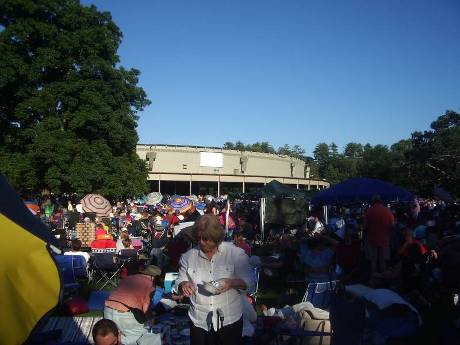
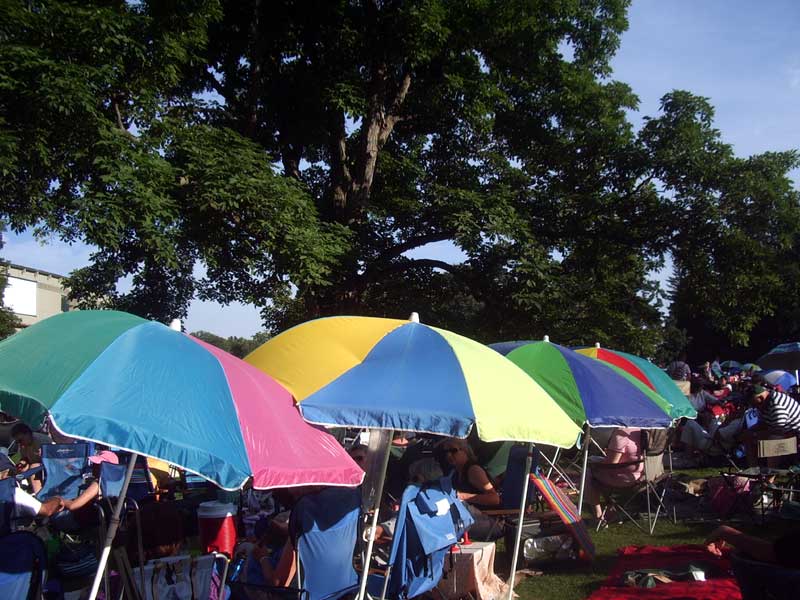
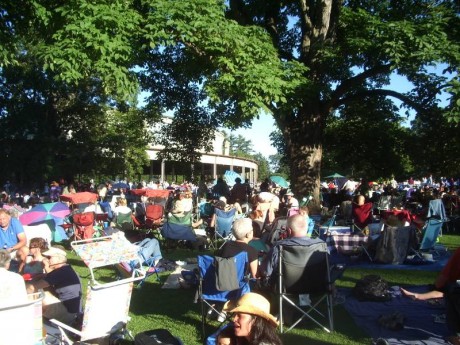
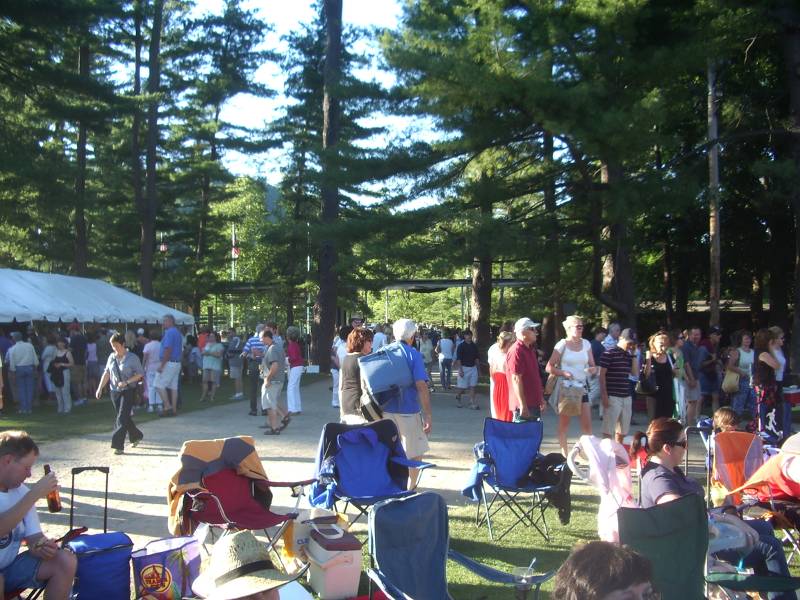
Audience view on the lawn at Tanglewood. BerkshireLinks.com photo.Previn followed Ozawa on the podium to conduct the TMC orchestra performing Benjamin Britten;s Sinfonia de Requiem, which was commissioned in celebration of the 2600-year history of Imperial Japan in 1940. Previn, whose conducting style looks the antithesis of Ozawa’s, elicited a fine performance from the orchestra, which brought the piece to a stirring close.

Lockhart and the Pops opened the second half of the program with the very engaging and intriguing Convergence: Concerto for Pops Orchestra, which was commissioned just last year by the BSO and premiered at Symphony Hall on May 16. As the 49 year old Brubeck wrote then, “They wanted a piece that would weave classical, jazz, and even funk elements…to challenge and showcase all the sections of the orchestra.” Well, he scored big time, particularly in the second movement which had great jazz elements, including a trumpet and trombone duet, some deft brushwork by the drummer, and a teasing coda that fooled many in the audience.

This august institution on sacred grounds amid these hallowed hills being all about tradition, a new one seems to be Pops emeritus conductor John Williams‘ cienmatic interlude. This year’s entry was “Hedwig’s Theme” from the upcoming blockbuster movie, Harry Potter and the Sorcerer’s Stone. Williams followed that with the lovely A Hymn to New England, which he wrote to accompany a documentary-travelogue for the Museum of Science in Boston.

Then Williams made the presentation to Ozawa of the cannon, which was rolled onto the stage temporarily. After brief remarks by the Mastro, he led the combined orchestras in a fresh and powerful rendition of Tchaikovsky’s famous overture. One wonders what thoughts lay behind the enigmatic expression on Ozawa’s face as he turned to cue the cannoneers one last time? Everything else was clear as a bell, including the sky over Stockbridge Bowl where the fireworks show brought a brilliant close to a memorable day.

  • « Go to Previous Page
  • Page 1
  • Interim pages omitted …
  • Page 30
  • Page 31
  • Page 32
  • Page 33
  • Page 34
  • Interim pages omitted …
  • Page 39
  • Go to Next Page »

Copyright © 2026 · RWCtwos on Genesis Framework · WordPress · Log in

  • Tanglewood reviews
  • Tanglewood schedule
  • The Berkshires
  • Contact